Working title
Catena
A map of Delaware case law built from scratch for lawyers and research agents at the same time. Designed so a human or an agent can traverse the links between cases quickly and understand what the law means, not just collect superficially useful quotes.
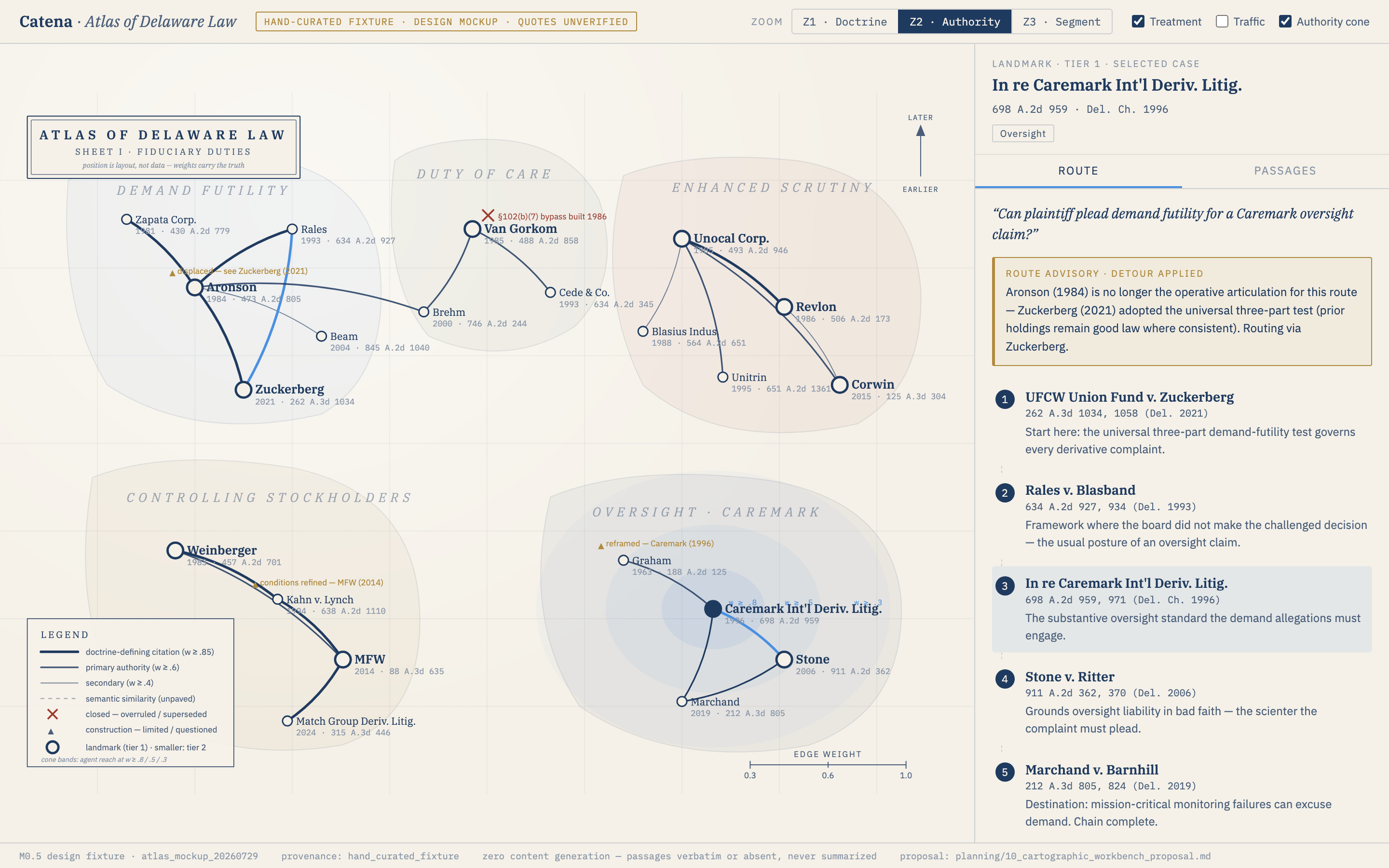
Design study for the atlas interface. Doctrine reads as territory, citations as roads, an authority chain as a route.
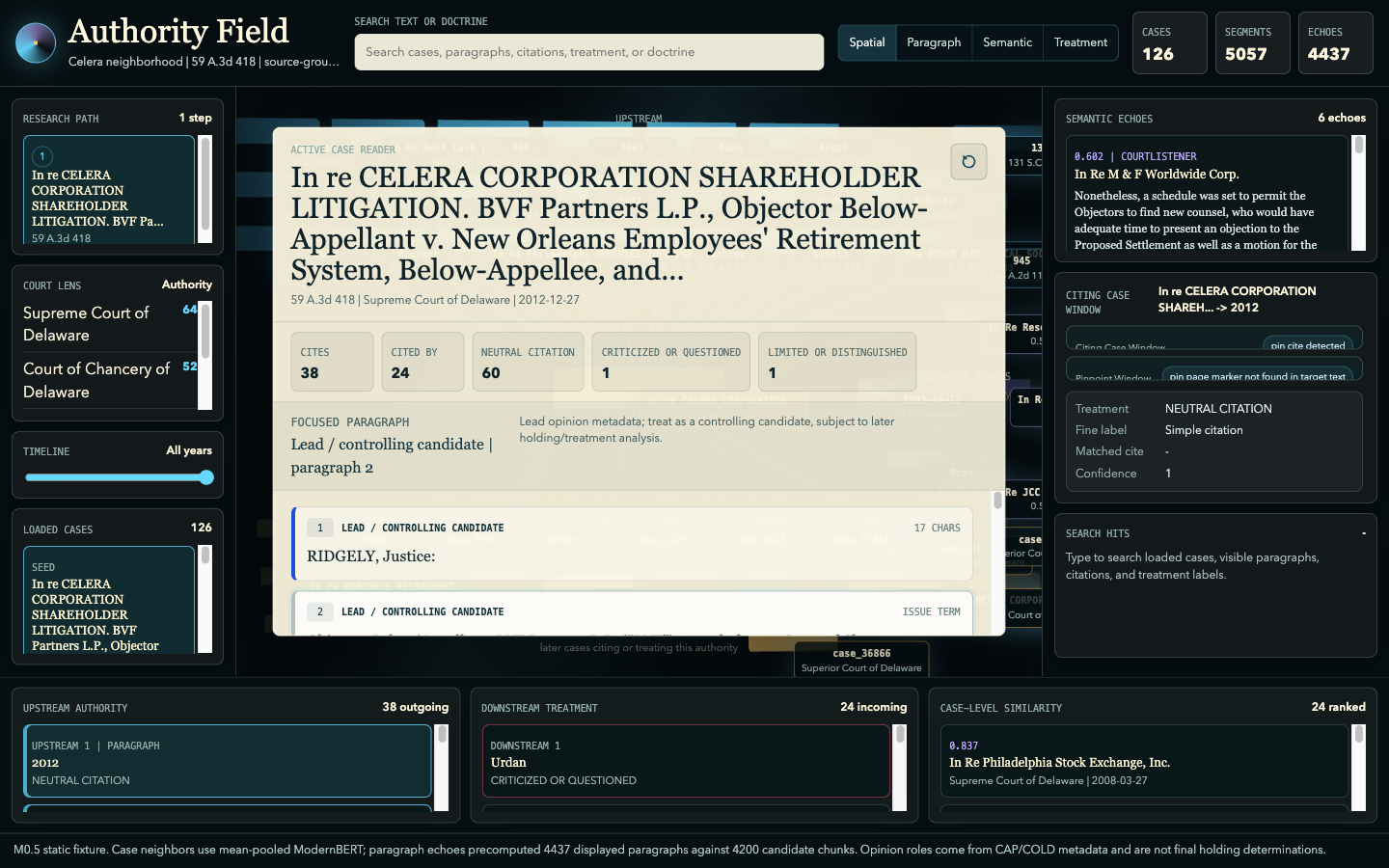
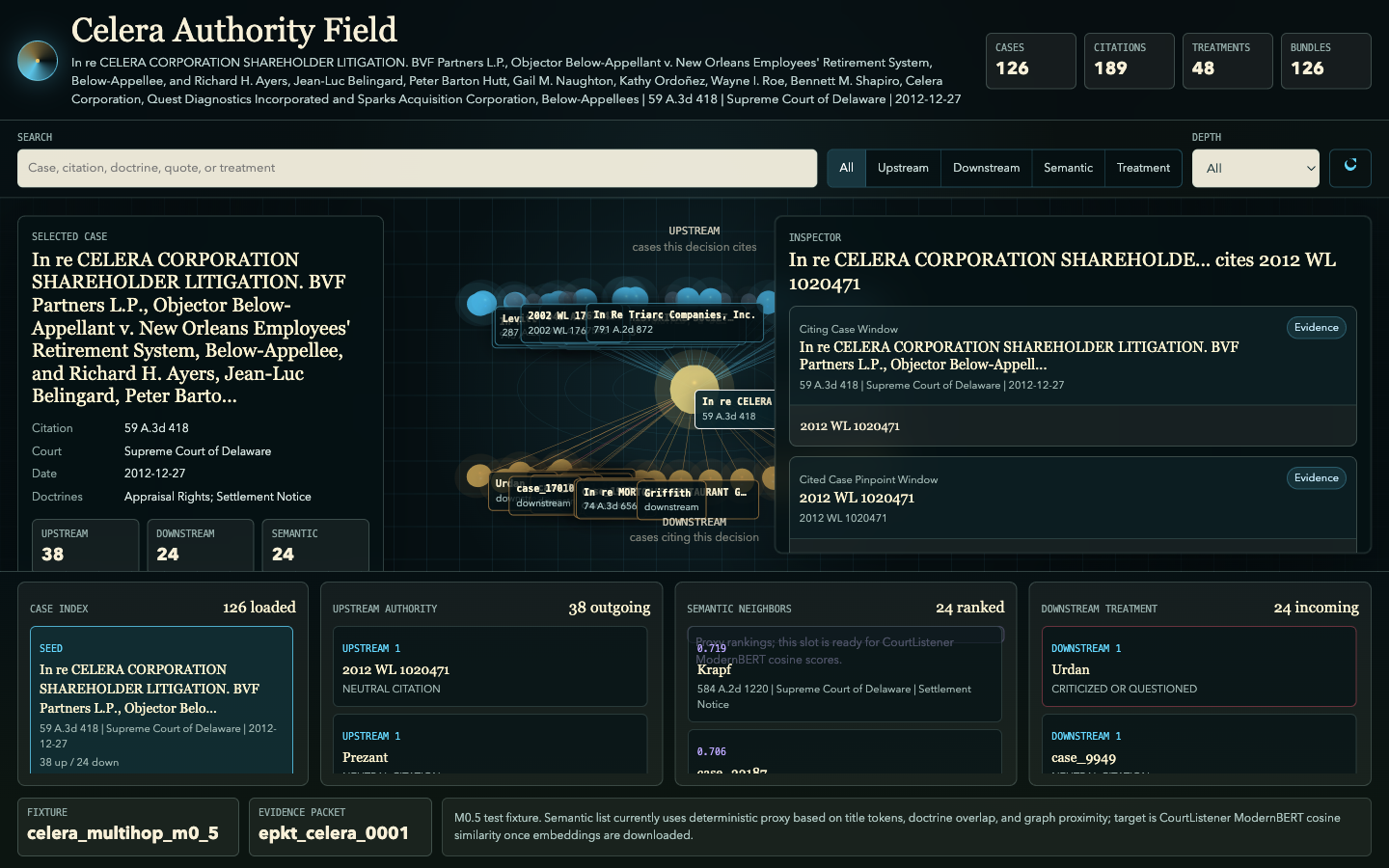
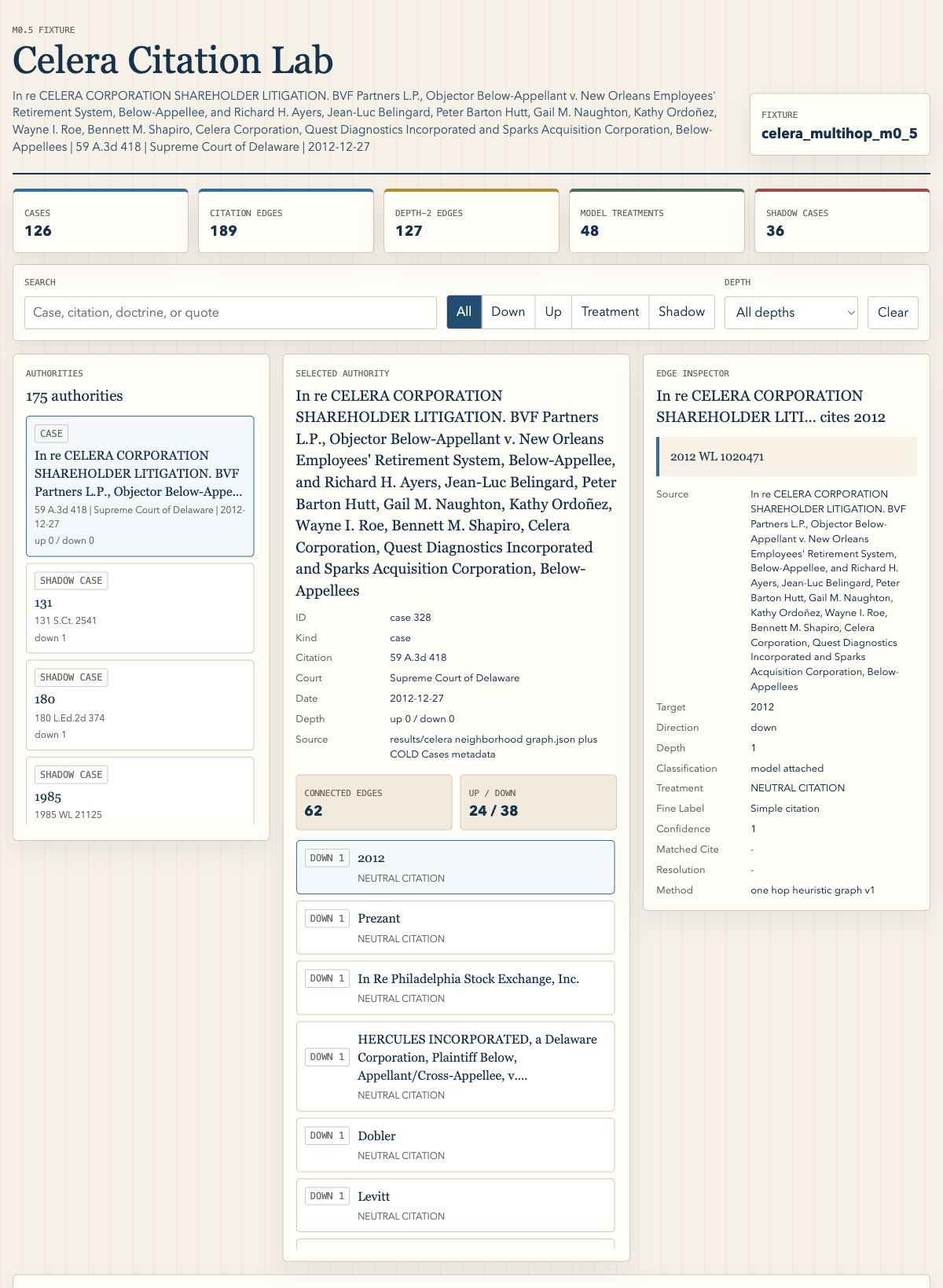
Earlier interface studies: authority cockpit, authority field, citation lab
The Thesis
Westlaw and Lexis organize case law the way a librarian would in 1995: pages of prose, headnotes, keyword search. The AI assistants arrived later and sit on top. Underneath, the data never changed shape. I think there is room for a research tool whose data layer assumes from the first design meeting that half its readers will be machines, and this project is how I'm finding out.
Hallucination is why the data layer matters. Stanford researchers found that general-purpose language models invent law in 58 to 88 percent of legal queries. Purpose-built legal AI tools still get it wrong 17 to 33 percent of the time, and the usual failure is subtle: a real citation to a real case that never said the thing it's cited for. Courts had sanctioned lawyers in over 1,300 matters for fabricated citations as of April 2026. After reading that literature I stopped believing retrieval tweaks would fix it. A tool that only quotes sources, word for word, leaves a fabricated quote nowhere to hide.
The quoting rule has a second audience. Roughly 92 percent of low-income Americans with a civil legal problem get no legal help at all. If a tool can only show real passages from real cases, you can hand it to someone who has no lawyer to check its work. I care about that outcome as much as the commercial one.
The Vision
The product is a graph. Take every Delaware decision, break it into paragraphs, and link each paragraph to the others in the corpus that bear on it. Each link records the kind of relationship and its strength. A direct quotation earns a heavy link. A loose conceptual echo earns a faint one. Citations, negative treatment, doctrinal application, statutory construction, and semantic similarity each get their own edge type in the same graph.
"See all of the law": every paragraph of every Delaware decision, navigable by following the links.
A person reads this graph through a map interface. An agent reads it through a Model Context Protocol server. Both hit one backend, and the operations are kept deliberately small. Find the cases that treat this one negatively. Trace a doctrine across a date range. Return the authority cone around this paragraph, down to a stated weight.
The Cartography Turn
In July a question from outside law changed the project's direction: how does a mapping service answer a continent-scale routing query in milliseconds? Route planners spend hours of offline work discovering the hierarchy already sitting in the road network, so that any single query touches only a small skeleton. Nobody imposes the highways. They get found in the data. Case law looked like it should have the same shape, and landmark cases read like interstates.
The analogy kept producing ideas once I pushed on it. The project's authority-cone query turns out to be what mapping people call an isochrone, meaning everything reachable within a cost budget of a starting point. A chain of authority in a brief is a route. An overruling is a road closure, which suggests a feature no commercial citator offers: when a case in your chain gets limited, show the detour through the surviving line.
An agent's context window is a travel budget. Zoom levels answer the same bandwidth problem for a language model that map tiles answered for a dial-up connection.
I turned the hunch into two research tasks rather than an assumption. One surveyed the route-planning literature technique by technique against the system's query catalog. The other measured the real Delaware citation network, 39,278 opinions and 125,478 resolved citation links, to test what I had been calling the doctrinal-highway hypothesis: that a couple hundred landmark cases sit on nearly every long citation path.
That hypothesis failed. The top 200 cases cover 67.5 percent of long paths, short of the 90 percent bar I had preregistered, and the heaviest traffic runs through procedural workhorses like Levitt v. Bouvier rather than Revlon or Aronson. Community detection told the better story. Delaware law clusters into 45 doctrinal neighborhoods, and the procedural cases are the roads between them. The metaphor held up. My first sketch of the geography did not, and finding that out cost one evening of compute instead of a quarter of engineering.
Why Delaware
The proof of concept covers Delaware case law and stops there: every Delaware court in the Caselaw Access Project, 39,278 opinions running from 1776 to 2023, sitting on my machine as Parquet from Harvard's COLD Cases dataset.
Delaware is the corpus I can grade. Corporate litigation is my practice area, so I can hand-label the evaluation set myself instead of outsourcing the judgment calls. Chancery opinions cite each other at an unusual density, which stresses the graph design early. It also happens to be the jurisdiction the commercial legal AI companies care about most. Once the architecture proves out here, the plan is to extend it to the jurisdictions where unrepresented people actually live their legal lives: housing, family, immigration, small claims.
Where It Stands
The rule I set at the start was to do the research before the spec and the spec before the code. That held for three months. The research phase produced twenty reports, nine recorded architecture decisions, a technical spec, and an evaluation plan with preregistered numeric targets. In late July the first working prototype went live on my desk: full-text passage search and a citation map over all 39,278 opinions. Its citation links carry no treatment labels yet, because the classifier that would type them hasn't been built, and the interface says so on every screen rather than pretending otherwise.
Settled so far, out of the research and synthesis work:
Treatment Taxonomy
16 labels in 5 groups, taken from Demir & Canbaz (2025), who extracted the structure from Hellyer's 2018 citator accuracy study.
Granularity
The paragraph is the unit of analysis, with sentence offsets wherever a pin cite needs something finer.
Edge Schema
One treatment edge type plus 19 others. About 19% of citing relationships support more than one label, so the classifier outputs sets.
Evaluation
Errors score by severity, since calling an overruled case good law is worse than fumbling a distinction. A hand-labeled Delaware gold set anchors the benchmark.
Storage
Postgres as source of truth with a Neo4j mirror. Edges are append-only and dated, so the graph answers questions as of any moment in time.
Interface
An MCP server first, a thin REST layer second, stateless throughout. The public access tier requires no account at all.
Up next: raising the citation resolution rate that bounds the graph study, hand-labeling the Delaware gold set, testing whether highways exist inside individual doctrinal neighborhoods, and the treatment classifier that turns bare citation links into typed ones.
The Slow Way
I've slowed this project down on purpose, twice. Most of what I build ships inside a month. This one carries more weight because the bet lives in the data layer, and you only get to design a data layer once. So before writing the spec I read what already existed: Hellyer's citator study, Qura's graph architecture, the LKIF ontology work, the CourtListener data model. When a decision in the spec can't be traced back to one of those readings or to a research report, the document has to say it's an exception and defend it.
The payoff showed up quickly. The highway hypothesis died in one evening of measurement because the evaluation criteria were written down before the test ran. I'd rather lose a hypothesis than an engineering quarter.
Catena is a working title. A catena of cases is a chain of authority, a sequence of decisions that together support a proposition. The name fit a system whose central operation is linking authority to authority.